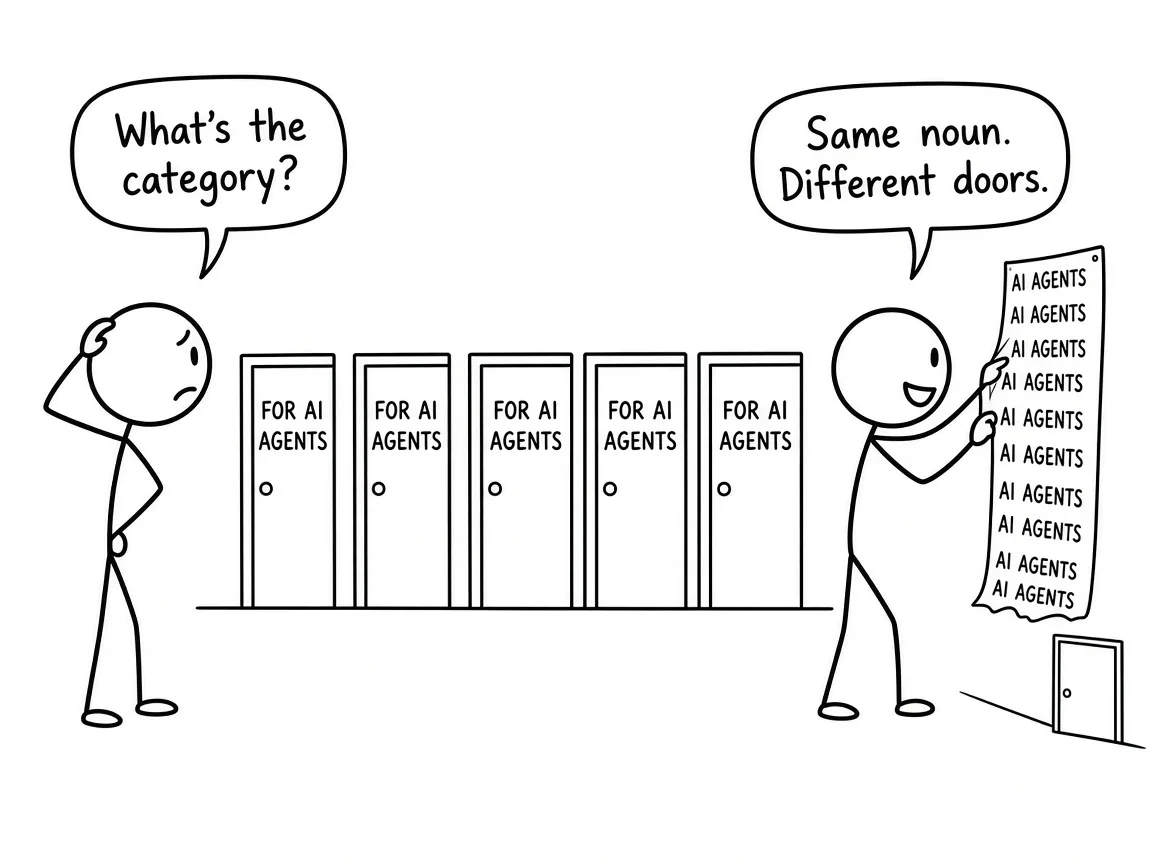
Two hundred and twenty vendor landing pages sit in our corpus. A hundred and forty-two of them reach for the same noun. At that density a noun is not a category. It is wall covering.
We counted the language, not the impression. Agents, multi-agent, workforce: a hundred and forty-two pages. Enterprise: seventy-five. A security or self-host strip: fifty-two. Orchestration or runtime: thirty-nine, and exactly thirty-nine more promise speed. Governance: thirty-five. When one noun covers two thirds of a market it has stopped sorting anybody. Your buyer has three tabs open and all three say it.
Nothing, as a description. Everything, as a position. Look at what the corpus does once you read past the noun: the market converged on the word and then split hard on the verb underneath it. Some pages sell govern — control plane, policy, approvals, audit. Some sell run: runtime, sandbox, durable execution. Some sell work, a digital worker you hire, twenty-six pages of that. Some sell build, the coding agent shelf, twenty-five. Some sell know: context, citations, a company brain, forty-two pages. Five different products wearing one noun. The verb carries the meaning. The noun carries nothing, and the noun is the part you put in your headline.
Operating system, control plane, kernel. Fifteen pages out of two hundred and twenty. That is the thinnest high-value shelf in the whole set. Sitting right beside it is a second fifteen: the number of pages that say anything at all about truth, grounding, citation or accuracy. Same count. A market that talks constantly about workers and almost never about what those workers know to be true. Read the two fifteens together and you have your opening paragraph.
It would be, except that it can be graded and the agent noun cannot. Nobody can check whether you have agents. Anybody can check whether you have an operating layer, because that claim makes structural promises. Five of them, in our reading. Is there a shared place where people work. Is there authority, meaning visible gate states rather than a permissions page. Is there an inventory of what may act and under whose policy. Is there a truth substrate under the screens. Does the loop close, from proposal through execution to a verified outcome. Three of those five have to be visible in the same product before the noun reads as earned. Fewer than three and you have a word.
So we went and looked instead of reading. Seven hundred and twelve captured landing viewports, every one labeled. Four hundred and eighty-nine are marketing only: a photo, a headline, abstract art, no product anywhere. A hundred and twenty-one show a readable work interface. Nineteen carry product chrome below the fold, which is where the honest screenshots tend to hide. The typical page in this market never shows you the thing. The noun is the only evidence on offer.
It gets narrower. Four of those seven hundred and twelve screens put an approval gate on the main surface. Four. Twenty-seven pages talk about human approval in the copy. That gap between what gets said and what gets shown is not a rounding error, it is the product opportunity, and it is sitting there in plain sight.
Name the layer and the mechanism in one breath, then let the rest of the page prove it. Operating layer is available and earnable. Control plane is available the moment you can show an inventory and a policy. Say where truth lives. Put the gate above the fold rather than in the footer. Then print one falsifiable number instead of nine feature cards: approval waiting split into slow and stalled, demand that arrived without anyone typing it, exposure raised before the delay lands. Almost nobody in this corpus markets a number they could be caught on, which is exactly why it reads as confidence.
And refuse the templates. Platform for AI agents is wallpaper with a frame around it. Enterprise-grade with no control sentence is trust theater. A logo strip with no outcome strip teaches the buyer that you are a brochure, and then the product turns out to be one.
Anytime. Count verbs on the next tab.