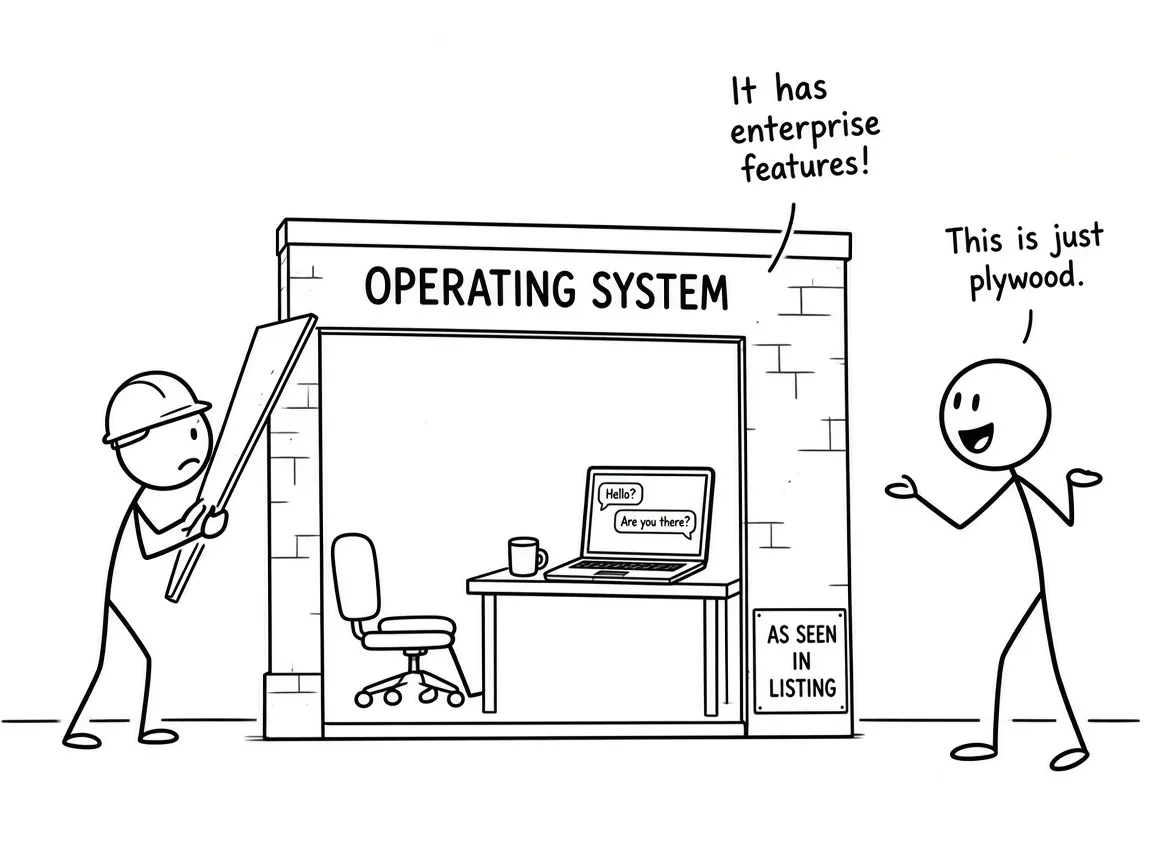
That is the myth. They have not made a claim you can hold them to. They picked a word nobody else was sitting on.
Fifteen pages out of the two hundred and twenty in our corpus reach for operating system, control plane or kernel. Cluster the same corpus by its main copy bet and those fifteen come back as a group of fifteen — against seventy pages doing enterprise governance and forty-four that are brand-only or too thin to classify at all. The shelf is real, and it is nearly empty. That is precisely what makes the word cheap. Scarcity makes it sound distinctive. Nothing about it is checkable from the noun alone.
Watch it in public. One vendor is filed as an operating system in its accelerator listing while its own live headline says all-in-one platform. Another sells an operating system for the built world and its first viewport contains no case, no queue, no gate, nothing an operator would recognise as a working product. Four more claim operating system or company brain while the captured screen is a marketing photograph or a grid of job cards. The word survives the screenshot every time, because the word is not load-bearing.
So stop grading the noun. Grade what has to be visible at the same time for the noun to be true.
Five pillars, from reading the peers who come closest. A shared place where people actually work — a workspace, rooms, job surfaces. Authority, meaning gate states and policy you can see, not a permissions tab. A control inventory: which agents exist, who owns them, what they may touch, how they get retired. A truth substrate: a graph, a ledger, a case, something underneath the screens that is not the screens. A closed loop, where a proposal runs through execution into a verified outcome and back into the record. Three of those five have to be co-visible in one product before the claim reads as earned. The best peers manage three. Nobody in this corpus manages five.
Then check the screenshot, because the screenshot is the part vendors cannot write. We labeled seven hundred and twelve captured landing viewports. Four hundred and eighty-nine are marketing only — photo hero, abstract art, headline, no chrome. A hundred and two are readable hero mocks. Nineteen more carry real product chrome below the fold, and those nineteen are usually the most honest pages in the set, because somebody scrolled past the poetry to show the queue. A hundred and two provisional rows sit in the middle, tagged from text extraction and not yet checked by eye; we do not quote those as peers.
A hundred and twenty-one screens out of seven hundred and twelve show an interface. That is seventeen per cent. Seventeen per cent is the honest denominator for every category claim in this market.
The navigation. Job-based navigation — Assistant, Service, Supervisor, Assessment — is a suite. It tells you the vendor has organised the product around the departments they sell into. Object-based navigation — cases, decisions, audit — is an operating layer, because it means truth has a home that outlives whichever job opened it. A suite can be excellent. It is not the same claim, and the pricing conversation that follows is a different conversation.
Two more reflexes worth keeping. Marketing that says OS while the viewport says nothing is non-evidence, full stop, until you can click from a front page to a case to a gate to an audit record. And a live demo beats a logo wall by a distance: the peers who put a running demo or a named production outcome on the page are the ones whose claim you can test in ninety seconds.
None of this means the word is wrong. It means the word is a promissory note. The replacement is not another noun, it is a verb: grade it. Show the pillars, in the product, above the fold, before you ask anyone to accept the category. Say the layer, then show the gate. If you can only show the gate, show the gate and skip the noun — you will be ahead of a hundred and forty-two pages that had nothing but nouns to begin with.
Glad it landed. Grade the screenshot next.