Fifteen of the two hundred and twenty vendor landing pages in our corpus say anything at all about truth, grounding, citation or accuracy. Fifteen.
Same count as the pages claiming to be an operating system, which is a coincidence worth two sentences. Both are claims about structure underneath the product rather than features on top of it. Both require something to exist before it can be shown. So both are rare, and for the same reason.
Take the method apart before you spend the number, because a number you cannot explain is a number somebody will take off you later. This is a keyword match across two hundred and twenty vendor page syntheses — one per company, built from the fetched landing copy. It counts pages whose text reaches for that family of words. It does not count products that ground their answers well and never mention it. It does not reach anything rendered only after a script runs, and a few of the thinner extractions are close to unusable. What it measures precisely is this: how often this market thinks accuracy is worth selling. The answer is seven times in a hundred.
Slip. Ask any operations team how late a job is and you will get a number. Ask where the number comes from and you will get a date in a field. Ask who last changed that date and when, and the room goes quiet — because the date has been edited three times, each time by somebody entirely reasonable, each time for a defensible cause, and every edit quietly erased the evidence that the plan ever said something else.
That is not dishonesty. It is a schema with one slot for two facts.
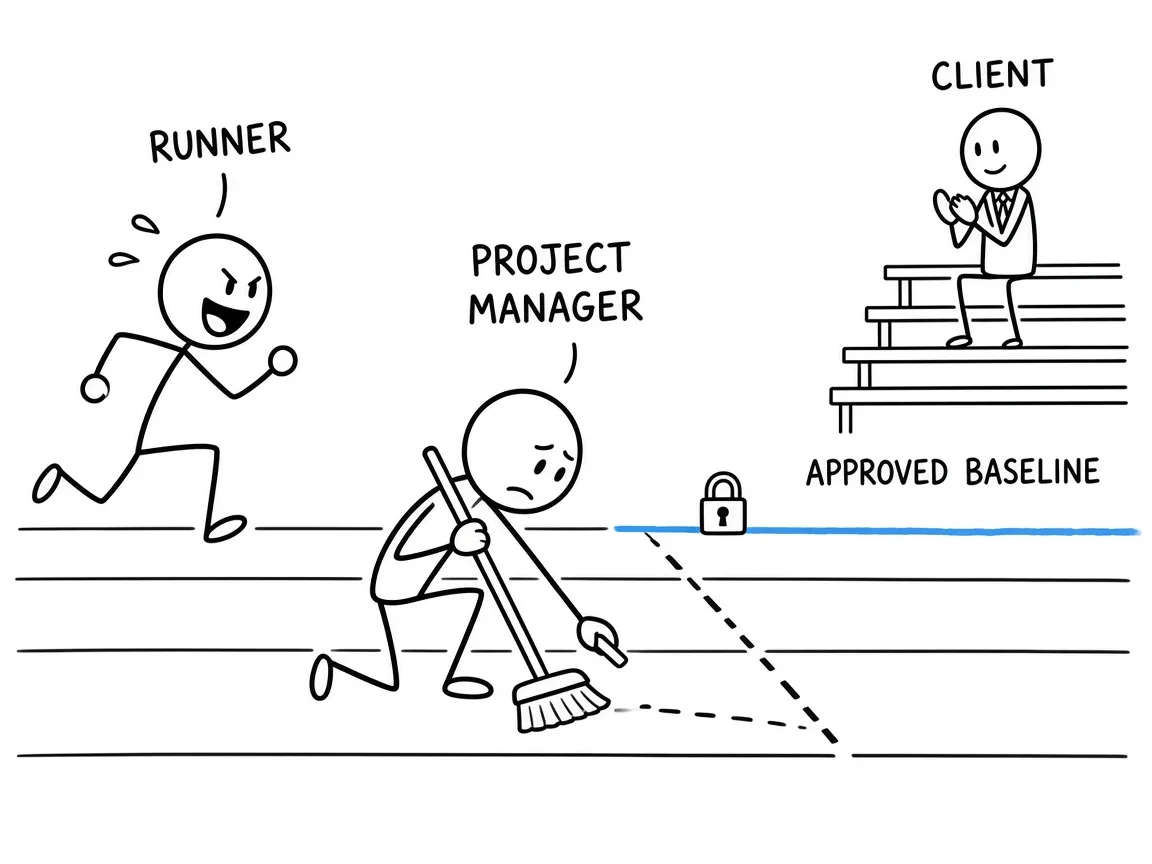
Slip needs two objects held apart. There is the approved baseline: the plan that was agreed, frozen at the moment of agreement, changed only through a decision that leaves a record. And there is the current timeline: what you are actually running today, which moves constantly and should. The difference between them is the only honest slip measure there is. Collapse them into one editable field and slip becomes unmeasurable by construction — not hidden, not under-reported, genuinely not computable, because the comparison has nothing to compare against.
Every downstream question depends on that separation. Did the project slip, or did the plan get rewritten to match reality? Which decision moved it? What did we know at the moment we agreed, and what arrived after? The last one is the whole basis for evaluating a system honestly: look at what went wrong, then ask what would have happened if the right signal had arrived at the right time. You cannot run that review against a field that overwrites itself.
Almost never. In the entire corpus, one vendor puts the words approved baseline on screen, sitting beside a scenario and an open gate with an engineer's approval attached — a small piece of chrome that happens to admit the two objects are different records. It is a grid product in a different domain and we would not copy the grid. The vocabulary is worth taking, exactly as it is. A second vendor shows exceptions with an average age in days, which is the same instinct applied to waiting rather than to schedule: a number that only exists because somebody kept the original timestamp instead of updating a status.
Two ways to hold it right. Make the baseline a decision, not a setting — it becomes true when someone approves it, and re-baselining is another approval with a name and a reason on it. Then make the current timeline a projection, free to move as often as the world does, because nothing depends on its stability. The board can show either. It must never be the place where one silently becomes the other.
Now, what not to do with the fifteen.
Do not turn it into a claim about how much this market cares about being correct. It is a count of marketing language, not a census of engineering. Several vendors with the most careful grounding in the set never use the word.
Do not put it in a hero as a statistic about competitors. A number aimed at other people tells a buyer nothing about you, and buyers have learned to discount it.
And do not treat scarcity as a strategy on its own. The shelf is empty because the claim is expensive, not because nobody thought of it. Saying truth costs nothing. Holding a baseline apart from a timeline, through every edit, in a way you could reconstruct in front of a client twelve months later, costs quite a lot — and it is the only version of the claim that survives being checked.
Fifteen pages talk about truth. The interesting question is not why so few. It is what the other two hundred and five are measuring slip against.
Later. Hold the baseline still.