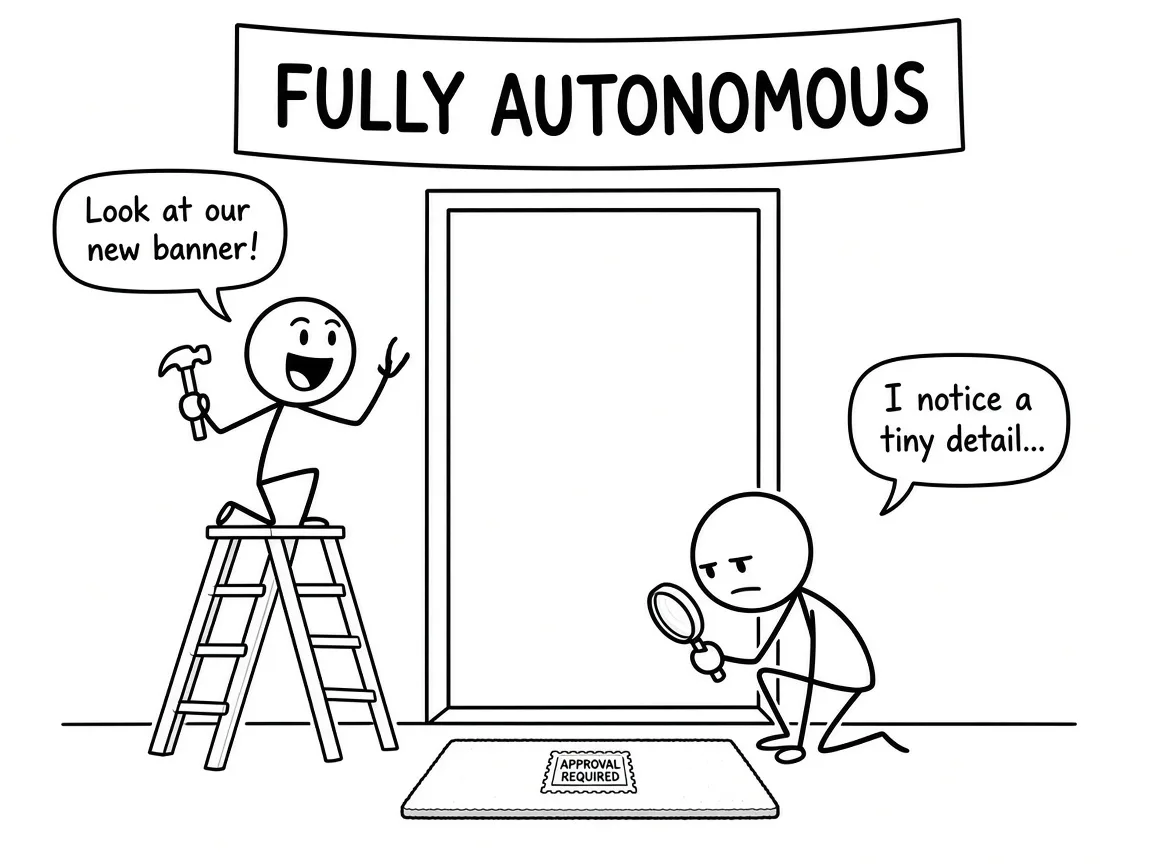
You have found the problem yourself. Write fully autonomous and the operations lead in the buying committee goes cold, because she has met software that acted on her behalf and she remembers what it cost. Write human in the loop and the whole page reads like a product that is not finished yet — a demo with a chaperone. So you are about to do what almost everyone in this market does. Pick one, say it loudly, and bury the other side in a footer nobody reads.
Do not. Both sides are true at once, and saying so is the strongest sentence available to you right now.
Around twenty pages in our two-hundred-and-twenty-page corpus lean on autonomy or unattended operation. Twenty-seven talk about approval, human judgment or a human in the loop. Those two sets barely overlap. Almost the entire market has picked a side and hoped the other one does not come up in the security review. It always comes up in the security review.
The handful of pages that name both sides read completely differently. One calls itself a human-in-the-loop runtime, which turns the constraint into the engineering. One says your agents act, you stay in control — nine words doing the work of a paragraph. One says humans are involved only at decision points, which is a promise about volume and quietly tells the reader that everything else is handled. The cleanest we found draws the line geographically: supervised at every external boundary. Autonomous inside, human at the edge. You read, you approve. Another puts it as a division of labour that a procurement officer could repeat back verbatim — agents execute, your policies decide.
None of those are compromises. They are all more confident than fully autonomous, because each one tells you where the edge is, and a product with a known edge is a product somebody can buy.
Never with an agent. Not as a value, as a structure. An agent proposes; it does not decide. If your interface ever shows an agent approving its own write, that is not a feature to describe carefully, it is a defect. The load-bearing pattern underneath every good version of this is the same three-step: a probabilistic proposal, then a deterministic policy check that does not involve a model, then an append-only record of what was allowed and why. Reasoning is untrusted. Enforcement is not. Once you have that, autonomy is not a personality setting — it is the size of the region inside the boundary, and you can widen it with evidence.
Which is the part your hero line can actually promise: that the boundary is declared, visible, and moves only when someone decides it should.
Autonomy absolutism loses deals quietly. The page never hears back. The operations lead did not argue with you; she just did not champion it internally, because she could not answer the one question her own risk people would ask. Every unqualified no humans needed is a sentence she has to defend without your help.
And the other side has a failure mode too, which almost nobody talks about. Human oversight is not an infinite safety net. It is a finite resource that gets tired. Route everything to a person and you have built a rubber stamp with a latency problem — reviewers habituate, approval becomes a reflex, and the gate keeps producing audit records while it stops producing judgment. Every serious framework hands you a pause primitive for free. Not one of them tells you whether your approval policy is any good. That question — which classes of action deserve a human, at what load, at what cost of being wrong — is real work, and it is measurable before you ship.
So write both sides. Then, and this matters more than the wording, show the gate. Of the seven hundred and twelve product screens we captured across this market, four lead with an approval gate. Four. Twenty-seven pages say the word. The scarce thing is not the claim, it is the chrome: a queue, a state, a name against a decision, a clock. Put that above the fold and your page is doing something almost nobody else's page does.
One line to steal the shape of, not the words: autonomous within a declared boundary; a human at every edge that costs money or time. Then spend the rest of the page proving the second half.
Your fourth draft is not stuck because the sentence is hard. It is stuck because you were trying to say one thing about a product that does two.
Good. Write both sides in one breath.