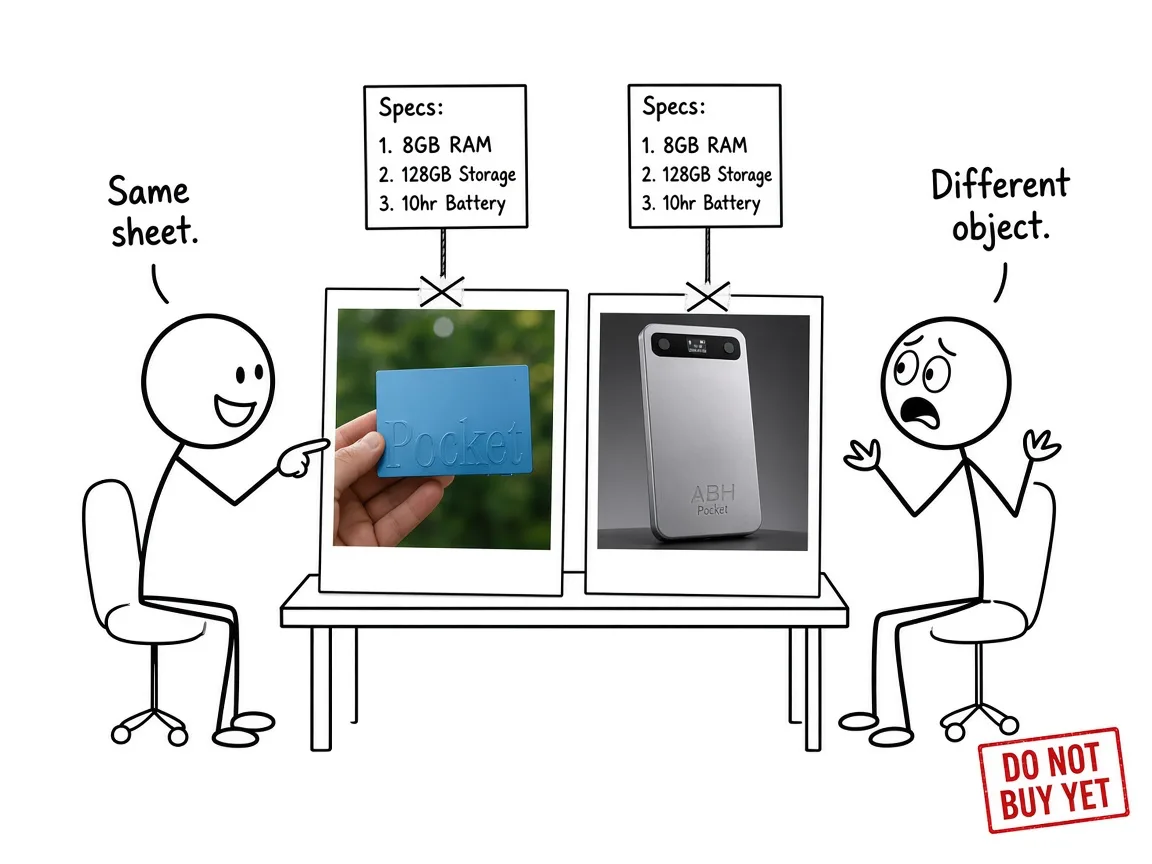
I opened a cheap listing that looks, on paper, like HeyPocket's Pocket. I would not buy it yet.
Because the page does not agree with itself. The interesting part is not the discount. It is that the numbers on ABH's Pocket page sit almost on top of Pocket's published hardware.
Sixty-four gigabytes. Two room mics. One contact mic. Fifteen metres claimed. Four days of battery. About an hour and a half to charge. Bluetooth Low Energy. Wi-Fi. USB-C. About fifty-two grams. A hundred and twenty languages-plus. ABH writes those out. HeyPocket publishes the same kind of sheet.
That is the moment you think: private label. Same Shenzhen board, different stamp.
And that is technically plausible. The FCC filing for Pocket names the applicant as Shenzhen Jingwah Information Technology Co., Ltd., ID RBD-PKT01. Jingwah's model-difference letter is the smoking paper: the PKT01 / PKTXXX family can wear different buyer names while keeping the same internals, the same circuits, the same parts. Pocket itself already sits on OEM hardware.
Look at the photos.
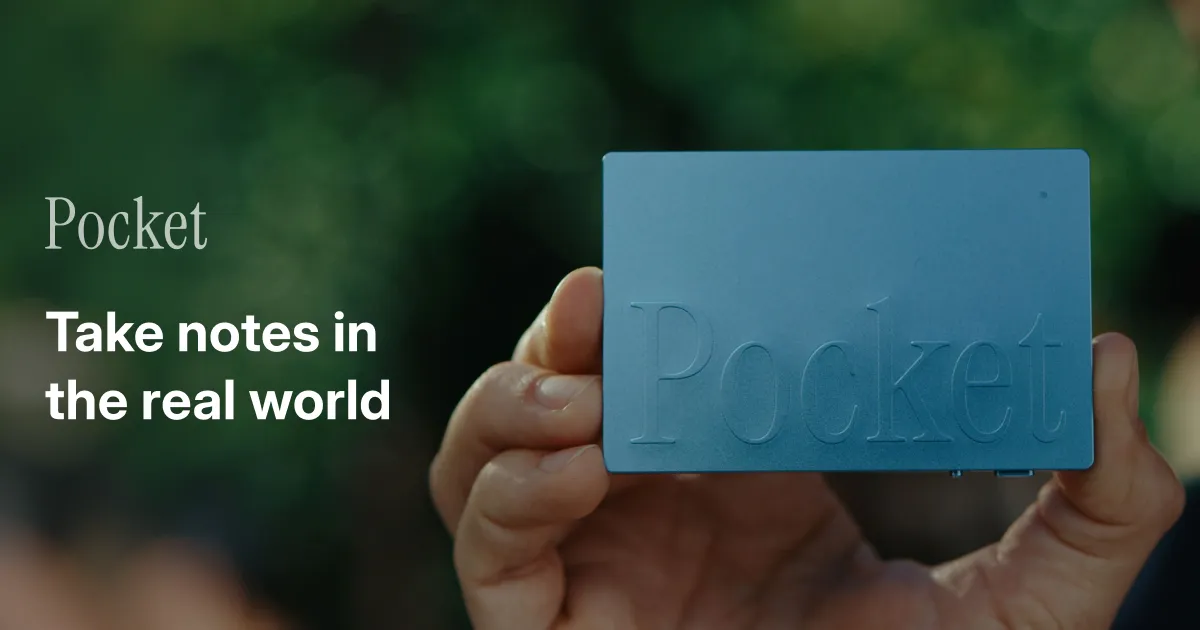
Pocket is a screenless card. Big embossed word. No display. That is the object people mean when they say PKT01.
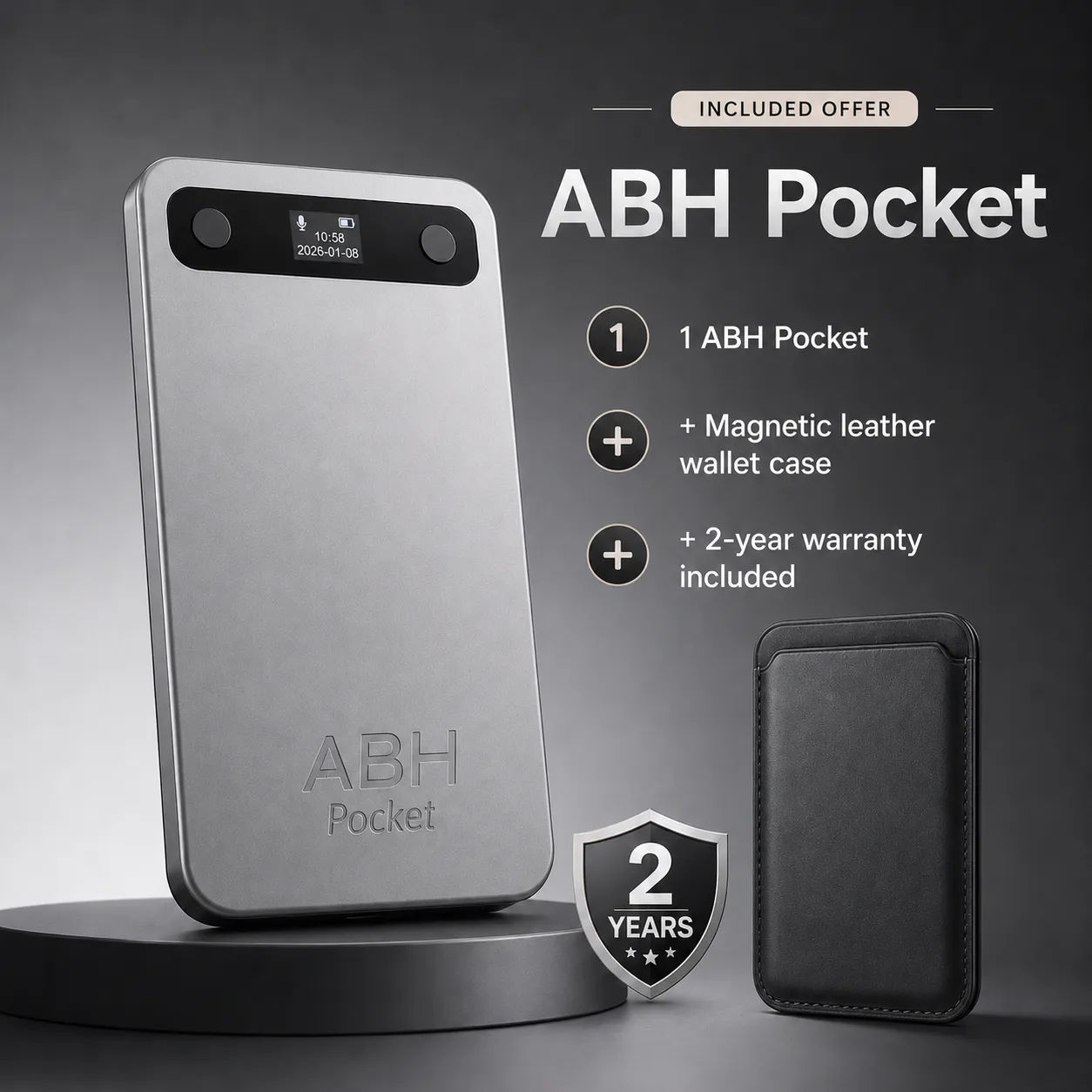
ABH shows a silver card with a black bar and a tiny screen. The spec table never mentions a display. It just repeats the Pocket numbers.
Three reads, and I cannot pick one from the page:
A. A different Jingwah revision, Pocket-like numbers reused.
B. Another generic recorder, competitor sheet copied.
C. Marketing renders that are not the object in the box.
Until one of those is dead, I will not treat this as a cheap Pocket. The Germany listing I opened even sells capacity as eight, sixteen, and sixty-four gigabytes, while the table on the same brand still talks like sixty-four is the device. That is not how an honest SKU line reads.
ABH does not describe itself as a recorder company. About says it is an e-commerce shop selecting consumer products, an individual business in Madrid. Fine, if the object is named. The product page I opened does not name the app. Recordings "sync to the app." No App Store link. No Play link. I could not find a Model Context Protocol surface, an API, or developer docs. That absence is the contrast with real Pocket, which publishes both.
The review block I opened said based on ten reviews. Ignore the star theatre above it.
That is the fake. Rare and easy are not opposites. A spec sheet that matches Pocket is easy. A model number, an FCC ID, and a store listing for the actual app are the rare part. Without those, you bought a render.
Because the real PKT01 has two doors, and I mixed them up.
The official door is Pocket's cloud. MCP docs give a remote server at https://public.heypocketai.com/mcp, OAuth or a pk_ key, and a claude mcp add line for Claude Code. That is a normal Model Context Protocol install, not a hack. Anthropic's CLI already has claude mcp. The public API is the same cloud with recordings, transcripts, summaries, and semantic search. You can pull a signed audio URL, not only their transcript. Webhooks fire transcription.completed, summary.completed, recording.created. That is how you kick your own pipeline after their cloud is done.
Pocket → Pocket cloud → Pocket MCP or API → Claude Code.
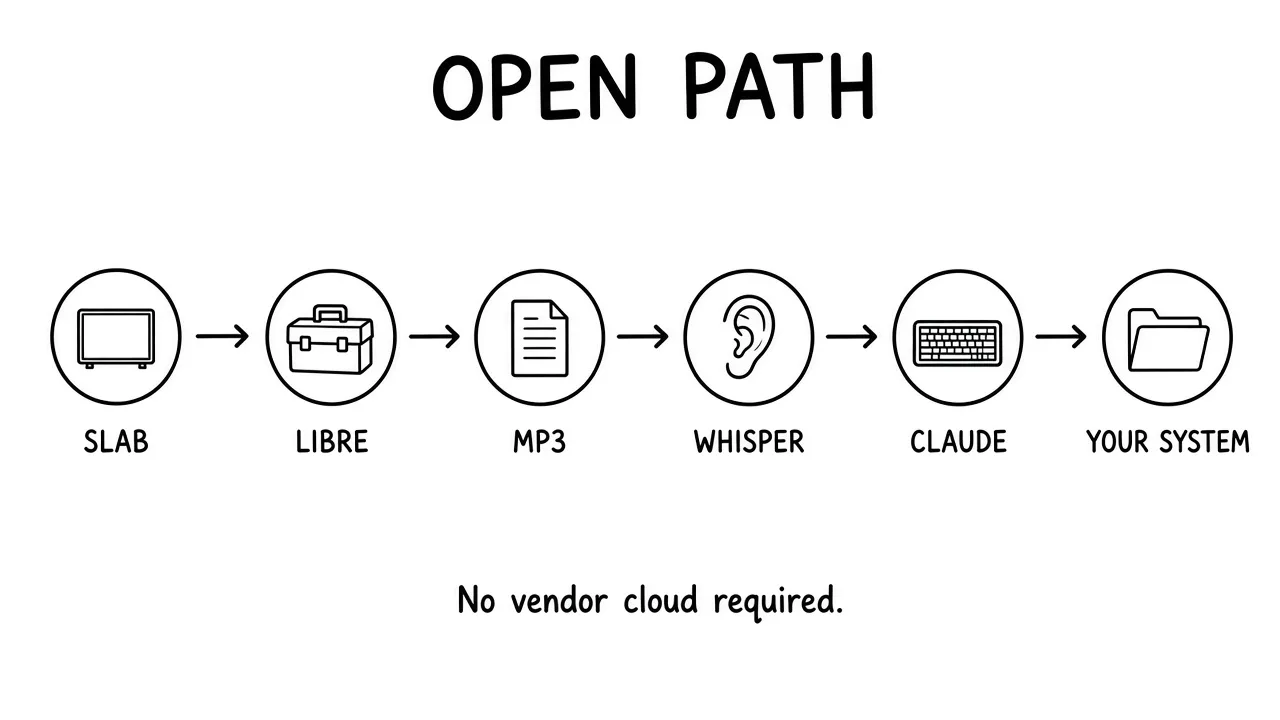
The other door does not wait for that cloud. pocket-libre is MIT. It talks to the slab over BLE, lists files, downloads ordinary MP3, transcribes locally with Whisper, diarizes, and summarizes with an Anthropic API key. Pocket's BLE protocol notes are the paper: ASCII GATT commands, 16 kHz mono MP3, no proprietary codec, no DRM. Session authenticate. Status, list, download. USB mass-storage on and off over BLE, checked on hardware. Wi-Fi bulk transfer is mapped and not finished. Do not pretend it is.
PKT01 → pocket-libre → local MP3 → local Whisper → Anthropic API, then files Claude Code can open.
No. That was the sloppy sentence. pocket-libre is local control of the recorder. Summaries go out through the Anthropic API if you turn them on. Transcription stays on the machine. The thing that plugs into Claude Code as an MCP server is Pocket's official cloud endpoint. pocket-libre gives you files. Claude Code works on files.
I used to pick Pocket for the vendor API. That route is still real, and now documented. The new fact is the open slab. If ABH is actually PKT01, that second route is why the model number matters.
Four questions before you spend the money
Ask ABH these, in writing, before you send a card.
- What model number is printed on the device? Is it PKT01, PKT02, or some PKTXXX?
- What is the FCC ID, or the CE model identifier?
- What is the direct App Store link, and the Google Play link, for the app this device uses?
- Can I pull recordings as files over USB-C without your cloud?
If they answer PKT01, or RBD-PKT01, or a compatible PKTXXX, this gets interesting. pocket-libre might speak it, or it might be a small fork. If they will not give a model and an FCC ID, I would not buy it.
The discovery is not "ABH is a cheaper Pocket." The discovery is that the underlying Pocket hardware is an OEM design, and the PKT01 protocol is now in the open. That is the closest thing I have found to the open recorder I originally wanted.
Ask for the FCC ID. Then I will listen.