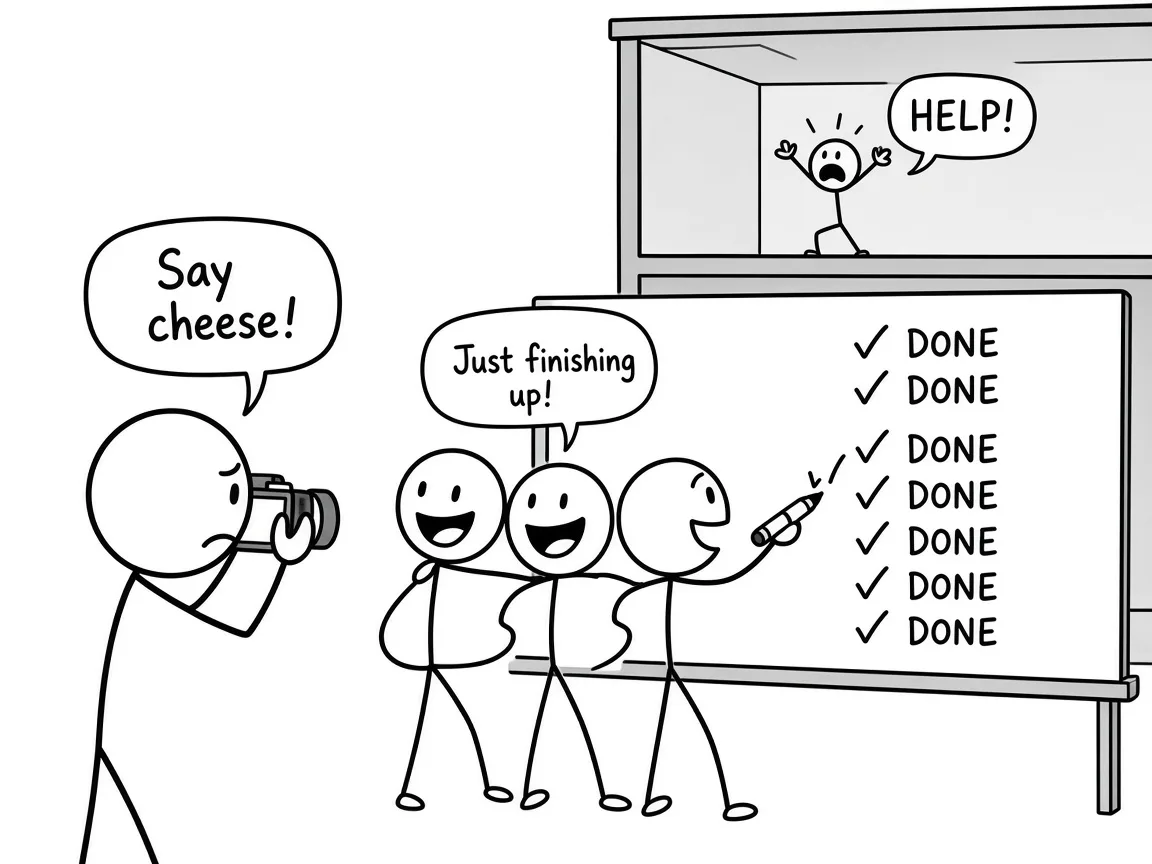
Picture the screen everyone stands in front of at twenty to nine. Rows down the left, a status column, a scatter of green, two cells in amber, one red that has been red long enough that nobody mentions it. It is the most trusted object in the building.
Every cell in it exists because a person remembered to type it, on a day when they had time, about work whose delay came from something nobody typed at all. That is the whole problem in one sentence, and it does not get better with a nicer board.
Look at what the status column is actually doing. It is one field carrying four different jobs. It carries who is waiting on whom, which it cannot express. It carries how long, which it rounds to a colour. It carries whether this is fine, which is a judgment nobody recorded. And it carries done, which is the worst of the four, because done here means a human clicked something — not that the order was placed, not that the supplier confirmed, not that the system of record on the other end agrees. A checklist of eight items gets pressed done at six. Everyone knows it. The board cannot know it, because the board has no idea what the other two were for.
Amber, or stuck, or pending, blends two states that behave nothing alike. One is an approval that is slow and perfectly healthy: it went out this morning, the person is in a meeting, it will land by four. The other is an approval that is stalled: nobody owns it, no clock is running against anybody, and it will sit there until it becomes a delivery date. Those need different treatment, different people, different escalation. On the board they are the same shade of orange.
And slip. Ask the board how late the job is and it will tell you the difference between today and the date currently in the cell — a date that has been edited, by hand, three times, each time by somebody being reasonable. There is no honest slip measure without two objects held apart: the baseline that was approved and the timeline you are actually running. One vendor in our whole corpus puts the words approved baseline on screen next to a scenario and a gate. One. It is the closest anybody comes to admitting that a plan and a promise are different records.
Zoom out and the shape explains itself. We labeled seven hundred and twelve captured product screens. A hundred and nineteen of them lead with a job or vertical workspace: a table, a Gantt, a drawing, an invoice grid. That family is the closest thing the market has to a case, and it is the single most common working surface anyone shows. Thirty-one have gate chrome anywhere on the page at all, mostly as a badge tucked beside something else.
We already said the gap between say and show is the opportunity. That matters here because boards photograph and gates do not.
Four of those seven hundred and twelve screens put an approval gate on the main surface.
— from Why “AI agents” became wallpaper (and what replaces the noun)
Same failure, different chrome: the market draws furniture beautifully and almost never draws the moment a human takes responsibility.
None of which means delete the board. The board is genuinely useful. It is just not the runtime.
Demote it and it becomes honest immediately. Make the columns gate states and exposure classes rather than typed statuses: awaiting a decision, stalled, exposed. Let every card open the situation behind it rather than an editable cell. And take away its write access to reality — editing a board should never invent a fact. When a board is a read-model over a ledger, the green is green because something was observed and verified, not because somebody was tidy on a Friday.
Four questions will tell you which kind of board you are looking at, and you can ask them in a demo. Can a user mark something done without a verified outcome from the system that would actually know? Can an agent act on a row without passing a gate the policy requires? Is the home screen a place where people type? Does the interface hold the approved baseline apart from the current plan? A no, a no, a no and a yes is an operating layer. Anything else is furniture.
So go back to twenty to nine. Same room, same screen. The rows are still there, but the first block is not statuses — it is three decisions waiting on people in that room, one of them marked stalled since Tuesday with a name against it. Underneath, two exposures that have not happened yet. Nobody in the room typed any of it. The board did not get smarter. It stopped being the source and started being the view.
Yeah. Demote the board, keep the view.