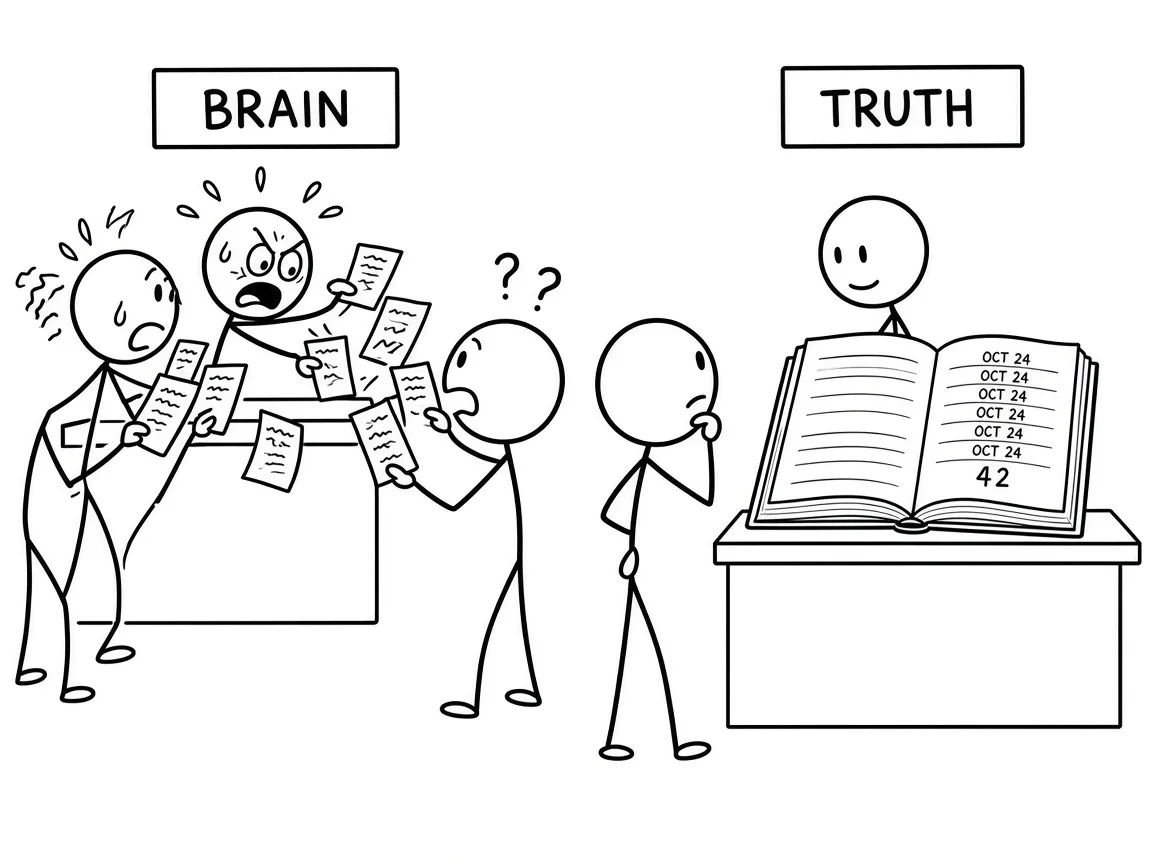
There are two serious answers to where a company keeps what it knows. They are not two versions of the same answer, and the difference decides what your product is allowed to do.
No. Forty-two of the two hundred and twenty landing pages in our corpus sell some form of it: memory, context, ontology, a living graph, a company brain. It is the third-largest language cluster in the market, and it is growing, because it demos beautifully. You ask, it knows. The best of them have earned the demo — one peer pairs an ontology with a live product you can drive and an explicit promise of no pipelines and no waiting, which is a real engineering claim, not a slogan.
The second answer is shared operational truth. One record of a situation, the same for everyone who opens it, with a history of how it got that way. Fifteen pages out of two hundred and twenty say anything at all about truth, grounding, citation or accuracy. That is the same count as the pages claiming to be an operating system, and it is not a coincidence: both nouns describe structure that has to exist before it can be shown, which is why almost nobody shows either.
The asker. That is its design goal and it achieves it. The answer is shaped by who asked, what they asked, and what was in the window. Two people asking the same thing on the same afternoon get two answers, both plausible, neither wrong exactly. Fine for a research assistant. Fatal for an approval, because an approval is a claim about a shared world, and you cannot approve against a personal recollection.
Operational truth answers the situation. The record does not care who opened it. That is the entire point and also the entire cost: someone has to decide what is allowed into it. An observation — a supplier wrote this, on this date, through this channel — goes in. An interpretation — therefore the order is at risk — goes in too, but labeled, attributed, and never mistaken for the first kind. Products that collapse the two have a fluent memory and no way to explain a bad conclusion, because the inference has already been promoted to a fact.
Chat context has no natural place for a decision. Approvals in a thread are messages. They scroll. Nobody can reconstruct, six weeks later, what evidence the approver actually saw at the moment they said go. Operational truth makes that reconstruction the default, which is unglamorous right up until the week somebody asks.
Chat context cannot be measured, and that is the quiet one. You can measure retrieval quality. You cannot measure whether the company waited four days on a decision, because there is no object that was waiting. A situation with a state has a clock on it. A conversation does not.
There is a structural reason, and it is worth naming: a vector index is not a system of record. The pieces do different jobs and want different guarantees. An append-only event ledger holds what happened, immutably. An operational store holds current state and has to serve read-your-writes, because an agent that decides against a stale read will make a confident mistake at speed. A vector index holds similarity, which is a search convenience, not a truth. Read-models — boards, front pages, exports — are projections over the first two and must never be writable back into them. The bridge between the mutable state and the immutable record is a transactional outbox, so that a fact and its publication either both happen or neither does. Fold all of that into one blob and you get a memory product. Keep them apart and you get a substrate other things can stand on.
We already said the board is not the runtime. That matters here because chat context fails the same way — it looks like memory and behaves like a view.
When a board is a read-model over a ledger, the green is green because something was observed and verified, not because somebody was tidy on a Friday.
Same failure, different chrome: if two accounts get two answers, you were shown a view, not shared truth.
The market's own screens agree, quietly. Of seven hundred and twelve captured product viewports, nine lead with memory or context chrome — a graph, a vault, a context filesystem. The truth layer is almost never drawn as a place a person goes. It is sold as an adjective on a chat box.
So which shelf do we occupy. The second one, deliberately, and with the cost accepted: shared operational truth, with the case as the unit and the ledger underneath it. Chat stays — it is the best entry point anyone has invented, and forbidding it is a usability tax with no upside. But chat opens a case and notifies about a case. It does not hold the company's answer. The moment a thread becomes the record, authority moves into whoever last spoke, and nothing after that can be audited, measured or defended.
Personal memory makes a person faster. Company truth makes an organisation decidable. Only one of those can be wrong in public.
You're welcome. Don't trust the brain counter.