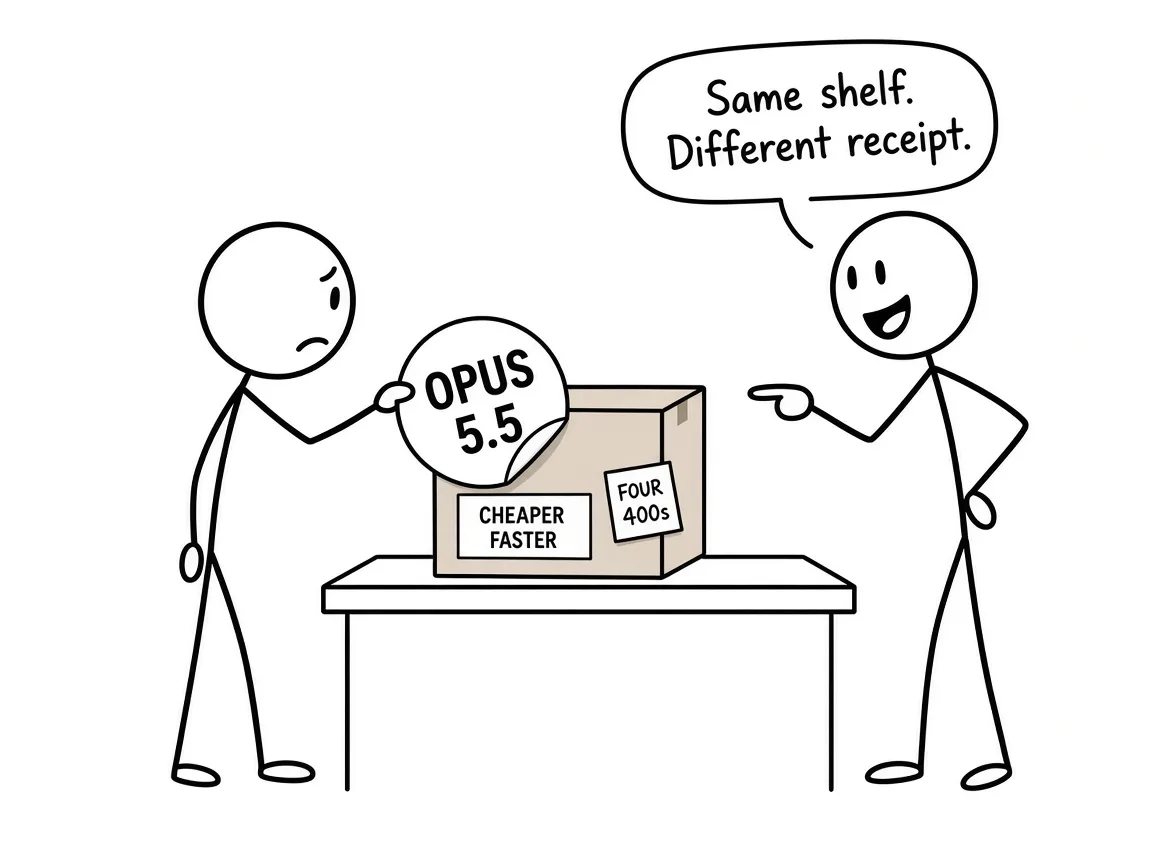
Claude Opus 5.5 shipped September twenty-second, twenty twenty-six — first model in the Claude 5.5 family, on the Claude API contract. Anthropic’s claim: Fable five point one level on most work, about forty percent less than Opus 5 on typical workloads at default settings — lower dollars per token and fewer tokens per task. The useful artifact is the migration surface, not the badge. Surfaces that consume it: Claude Code, IDE peers like Continue, gateways like LiteLLM / PortKey, optional phone front door OpenClaw, local weights via Ollama. Taxonomy: LLM Gateway · Coding Agents · Guardrails.
API id claude-opus-5-5. Bedrock: anthropic.claude-opus-5-5. Same string on Google Cloud, Microsoft Foundry, and Claude Platform on AWS. Context one million tokens. Sync max output one hundred twenty-eight thousand; Message Batches with the output-300k-2026-03-24 beta header goes to three hundred thousand. Knowledge and training cutoffs: June twenty twenty-six. Retirement not sooner than September twenty-second, twenty twenty-seven.
Base price: four dollars in / twenty dollars out per million tokens (Opus 5 was five / twenty-five). Prompt cache: five-minute write five dollars, one-hour write eight dollars, read twenty cents — that read is five percent of base input, down from Opus 5’s fifty cents. Batch API: fifty percent off input and output. Minimum cacheable prompt: five hundred twelve tokens. Anthropic’s own roll-up: about forty percent cheaper than Opus 5 at default settings on typical agentic/coding loads, because cache reads dominate those bills and output runs more than thirty percent faster. Fast mode (research preview, Claude API only — not Bedrock, not Google Cloud, not Foundry, not Claude Platform on AWS): speed: "fast" plus fast-mode-2026-02-01; Anthropic quotes up to about two point five times speed at eight dollars in / forty dollars out. Subscription side: higher five-hour caps on Pro, Max, Team, plus a banked rate-limit reset. Default effort on this model is medium (Fable five point one defaults high). Latency class: moderate. Full pack: Claude API.
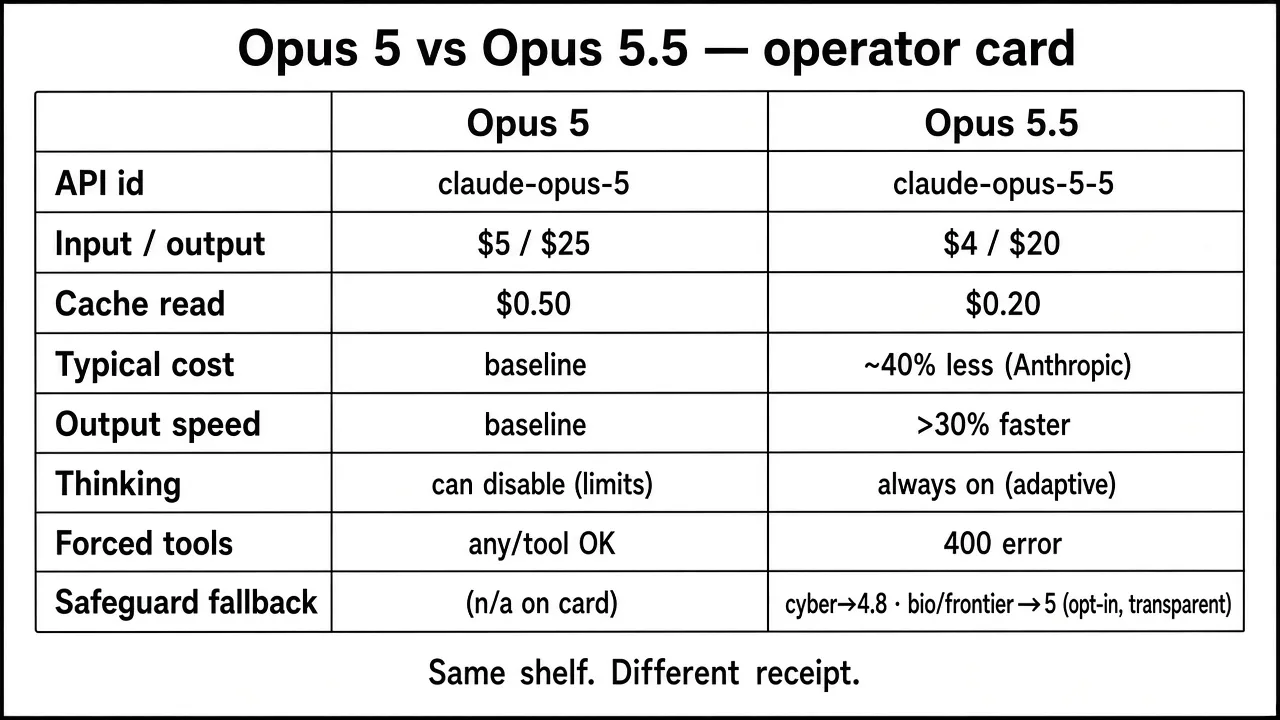
Four breaks on Anthropic’s whats-new page. Three of them also land on Fable five point one. Any wrapper — Claude Code, LiteLLM, OpenClaw Claude backend — inherits them.
One — thinking is adaptive-only. On Opus 5 you could still send thinking: {"type":"disabled"} at effort high or below. On Opus 5.5 that, and thinking: {"type":"enabled","budget_tokens":N}, return 400 invalid_request_error. Omit thinking, or send {"type":"adaptive"}. Depth, latency, and cost are steered with effort — lower effort where you used to disable thinking. Every response can open with one or more thinking blocks; at the default display: "omitted" the thinking field is empty. Select blocks by type, not by array index, and pass thinking blocks back unmodified in tool loops.
Two — forced tool use is dead. tool_choice of {"type":"any"} or {"type":"tool","name":"…"} returns four hundred: tool and any are not supported. auto and none stay. Same check on the token-counting endpoint. For schema-valid JSON: keep auto, set strict: true on the tool, or move the schema to structured outputs. If the model must call a tool, say when it applies in the prompt — do not force it in the request.
Three — thinking blocks are bound to model and conversation prefix. Each block records which model wrote it. Opus 5.5 reads thinking from Opus 5 and earlier Opus / Sonnet / Haiku; it does not read Fable or Mythos. On the Claude API, Fable five point one and Mythos five point one can read Opus 5.5 thinking; nothing else does. Switch Opus 5 → 5.5, or 5.5 → Fable/Mythos five point one, and reasoning can survive. Switch the other way, or onto a model outside that pair, and later turns run without the prior thoughts. Unreadable blocks are dropped before the model sees them: request succeeds, drop is not billed. With beta thinking-binding-controls-2026-08-01, drops show up in top-level input_transformations. The API also checks that system, tools, and earlier messages before a preserved Opus 5.5 thinking block have not changed since it was produced. On accounts created on or after August thirty-first, twenty twenty-six, UTC midnight, a replay after such a change is a four hundred by default on Claude API and cloud platforms. To drop instead: same beta header, thinking.block_binding.prefix_mismatch_behavior: "drop_block". Older accounts opt in by setting the field. Keep conversations append-only; change instructions or tools with mid-conversation system messages (and, with inline-tools-2026-09-15, a tool_addition block can carry a full tool definition without editing tools and without blowing the prompt cache).
Four — computer use tool type. On Claude API and Google Cloud, computer_20251124 (even with the old beta header) is refused: 'claude-opus-5-5' does not support tool types: computer_20251124. Migrate to {"type":"computer_toolset_20260801"}, drop the old beta, and update the agent loop for member tool_use blocks, batch actions, and toolset_name on results. Bedrock still accepts computer_20251124 on Opus 5.5. Browser-shaped peers such as Browser Use are a different cell (Tool Integration); do not confuse them with Anthropic’s computer toolset. Integrations already on the toolset need no change.
Quiet shape change (no four hundred): text between tool calls can live in thinking blocks that are empty under default display. A UI that streamed that text as progress goes silent until you set a display mode that returns it.
Anthropic’s table (adaptive thinking at max effort unless noted; production safeguards on): Terminal-Bench 4.0 sixty-six point four percent (xhigh; ± about two point six points), FrontierCode v1.1 main fifty-four point four, CursorBench 4.0 fifty-seven point eight, GDPval-AA v2.1 eighteen forty-six, AutomationBench forty percent (Zapier; safeguard hits counted as failures), Humanity’s Last Exam sixty-seven point seven with tools, Terminal-Bench-Science 0.1 fifty-eight point seven, OSWorld 2.0 eighty-one point eight partial, Chartography eighty-nine with tools. They also say at this tier bench margins understate how close Opus 5.5 and Fable five point one feel in daily use. Footnote that matters for evals: when safeguards fired in their harness, cyber tasks finished on Opus 4.8 and biology / frontier-LLM-dev tasks on Opus 5 — which lowers the Opus 5.5 number on those suites.
Production behavior is not a covert rewrite. System card: blocking classifiers are transparent (Guardrails territory). Cyber fallback → Opus 4.8. Biology (expanded CB classifiers, same family as Fable) and a narrow frontier-dev / RSI-adjacent class → Opus 5. Conventional weapons / high-yield and distillation / reasoning-extraction blocks have no fallback. First-party products and API clients that opt into fallbacks get that path; other hosts may differ. Declined request: HTTP two hundred, stop_reason: "refusal", stop_details naming the policy area — including a reasoning_extraction category. Configure server-side fallbacks: "default" (beta), SDK middleware, or your own retry — or put failover in LiteLLM / PortKey and still log the answering model. Log what you asked for and what answered:
Both belong in the record and they must not be the same row.
— from Observe → truth → propose → gate → humans decide (the loop as product spine)
Switch when you already pay Opus 5 for long agentic coding or knowledge work and you can ship: adaptive thinking + effort (not disabled / not budget_tokens); tool_choice only auto/none; append-only histories with mid-conversation system/tool adds; computer toolset on Claude API/GCP; UI that does not assume mid-tool plain text at default display; refusal + fallback logging that records the answering model. Wait if your loop indexes content by position, forces a named tool every turn, edits system/tools under preserved thinking on a new account, or still declares computer_20251124 outside Bedrock.
Claude Code / Continue / OpenClaw stay surfaces. Claude API is the brain contract. Opus 5.5 is a cheaper, faster brain with a sharper contract — not a company gate.
Buy the bill and the migration notes. The sticker comes free.