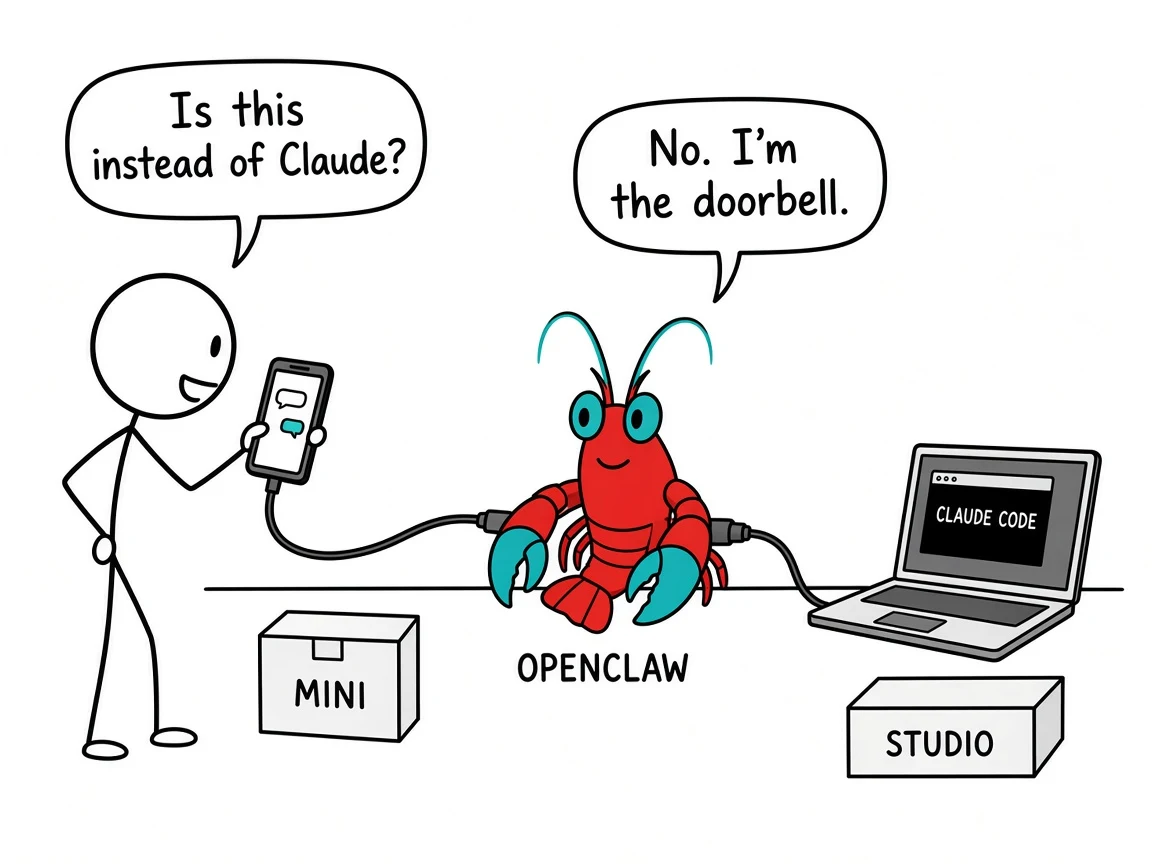
Claude is the brain. Claude Code is the brain in a repo. Neither is a standing assistant that lives in WhatsApp.
Not many reasons, and that is the point. You already have the hard part: a strong model, tools, and a coding agent on a project. OpenClaw is not a better Claude and not a second Claude Code. It is a self-hosted gateway — messaging channels in front of an agent on your machine, plus allowlists and exec policy around it. Everything else you already bought.
No. It can consume it. OpenClaw’s Anthropic docs describe two routes: an API key for pay-as-you-go, or Claude CLI reuse — talk to the installed claude executable on the same host so your existing Claude Code login stays owned by Claude. OpenClaw does not persist or refresh that native login; on a headless or shared Mac they prefer an API key because a stale CLI session just stops answering. Subscription claude -p still draws from the signed-in plan’s limits. WhatsApp or Telegram can reach that same paid Claude if you want the phone front door.
Not many, since you already have Claude Code. Only a few things are unique to OpenClaw.
Channels: you message from the phone; the agent answers in WhatsApp, Telegram, Signal, iMessage, Slack, Discord, Teams, Matrix, and the rest of their list. Claude Code stays at the keyboard.
Always-on gateway: heartbeats, allowFrom, pairing, a dedicated assistant number if you follow their guide. Persona lives in workspace files. Exec policy stays in OpenClaw even when the backend is Claude Code — permission modes map to OpenClaw’s exec rules; restricted jobs can expose only allowlisted tools through a grant-scoped MCP server instead of Claude’s full native set. Claude Code is session-shaped inside a project; this sits between check-ins. Same job as the govern shelf we already named — control plane, not another model label:
Some pages sell govern — control plane, policy, approvals, audit.
— from Why “AI agents” became wallpaper (and what replaces the noun)
Optional local runtime: keep Anthropic as primary, or point at another provider / Ollama. That is real, and it is hardware money, not OpenClaw magic. You still bought the cloud model with Claude Code; here you buy unified memory for weights. Reasoning quality, coding tools, and the Claude plan stay where they were.
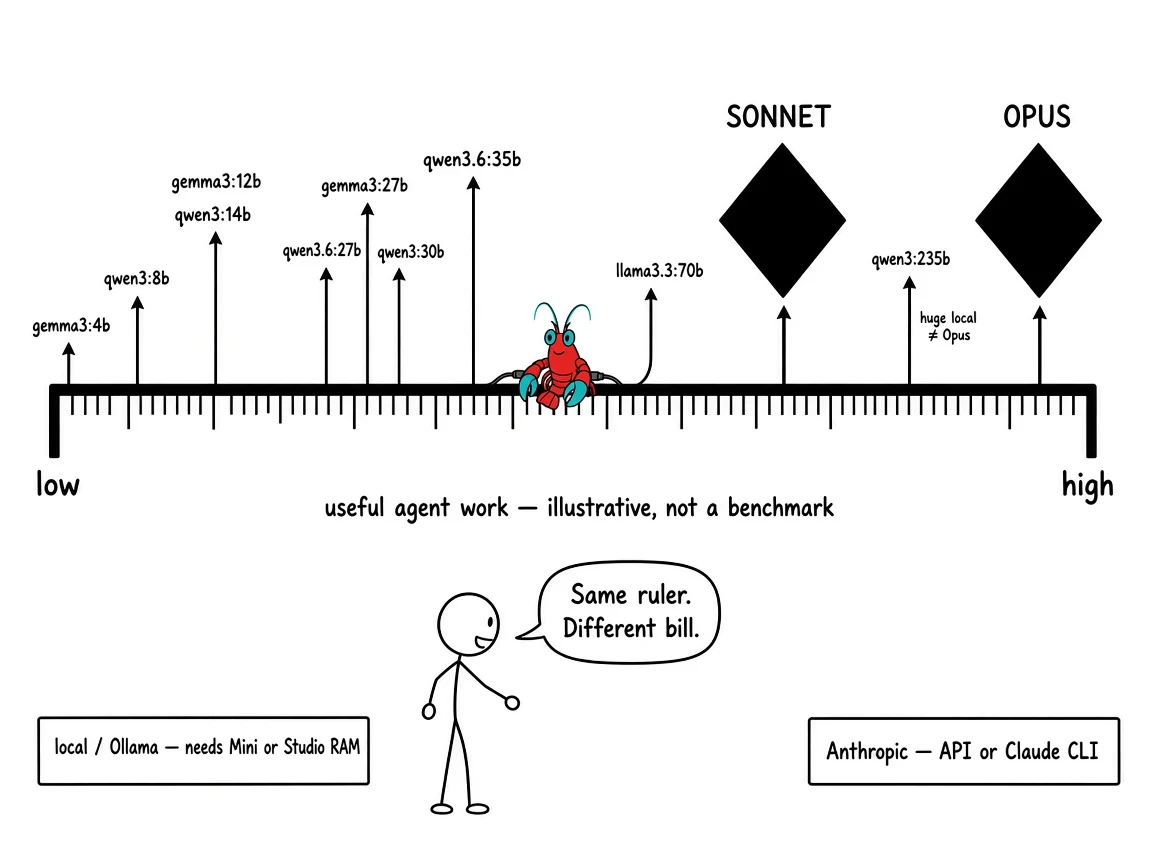
Then you are buying a host, not an OpenClaw feature. OpenClaw is open source; the box is not. Apple’s August twenty twenty-six newsroom prices (U.S.):
- Mac mini with M6 — from $899 (education $799). Base from sixteen gigabytes unified memory.
- Mac mini with M5 Pro — from $1,699 (education $1,599). Base at twenty-four gigabytes.
- Mac Studio with M5 Max — from $2,499 (education $2,299). Base at thirty-six gigabytes; Max configs climb toward one hundred twenty-eight.
- Mac Studio with M5 Ultra — from $5,499 (education $5,099). Base at ninety-six gigabytes; Ultra-class Studio marketed up to five hundred twelve for on-device frontier models.
Those are starting SKUs. The number that decides your local model is unified memory, not the mini-versus-Studio badge. Weights load into unified memory; OS and KV cache take more. Rule of thumb: unified memory at least the Ollama download size plus about eight gigabytes. That fails fast if you also leave a second model resident — qwen3.6:35b at 23 GB on a 48 GB box is fine until a long context and a second pull fight for the same RAM.
Default download path: Ollama library (ollama pull / ollama run; their pages list OpenClaw as ollama launch openclaw --model …). Alternate: Hugging Face mlx-community for Apple Silicon MLX quants. Verify live tags before you buy RAM — Ollama retags.
| Pull (Ollama) | Download | Comfortable RAM | Typical host |
|---|---|---|---|
qwen3:8b / gemma3:4b |
5.2 / 3.3 GB | 16 GB | Base mini |
qwen3:14b / gemma3:12b |
9.3 / 8.1 GB | 24 GB | Mini 24 GB |
qwen3.6:27b / gemma3:27b / qwen3:30b–32b |
17–20 GB | 32–48 GB | Mini Pro / Studio |
qwen3.6:35b |
23 GB | 48–64 GB | Mini Pro or Studio |
llama3.3:70b |
43 GB | 64 GB+ | Studio Max |
qwen3:235b |
142 GB | 192 GB+ | Ultra high-RAM only |
A mini is the cheap always-on host if “good enough local chat” is enough. A Studio is the jump for seventy-billion-class weights, bandwidth, or several residents — not for Telegram alone. If the primary model is still Claude, a mini is plenty as a gateway box; privacy is not “stays on the Mac,” and you still pay Claude. Mini-versus-Studio only bites when the model runs locally.
ollama pull qwen3.6:27b
ollama launch openclaw --model qwen3.6:27b
Three forks, not two. Stay in the IDE and claude.ai if you do not need channels or an always-on gateway — then skip OpenClaw. Use OpenClaw on a machine you already own when you want WhatsApp/Telegram in front of Claude, but start conservative: set allowFrom, prefer a dedicated number, disable heartbeats until you trust it. A middle case: notify-only Telegram on the same Mac as Claude Code — small gain, still real, not worth a new Studio. Buy Studio money only when a local model’s size and bandwidth are why you refused the cloud; a weak local model on a Studio buys silence, not Claude-grade reasoning. Qwen-class thirty-five billion privately is useful; it is not Claude Opus with a different badge.
Keep Claude Code for the repository. Add OpenClaw when you want standing chat channels and policy you host. Pay mini money for everyday local weights; pay Studio money for seventy-billion-class residents.
Well, now you know how open this claw really is.