Preview (WebP). Download the PDF for print.
Retrieval · RAG vs vector databases
We need RAG - buy a vector DB?
Same shelf, different job…
A2 · 420 × 594 mm · print-first
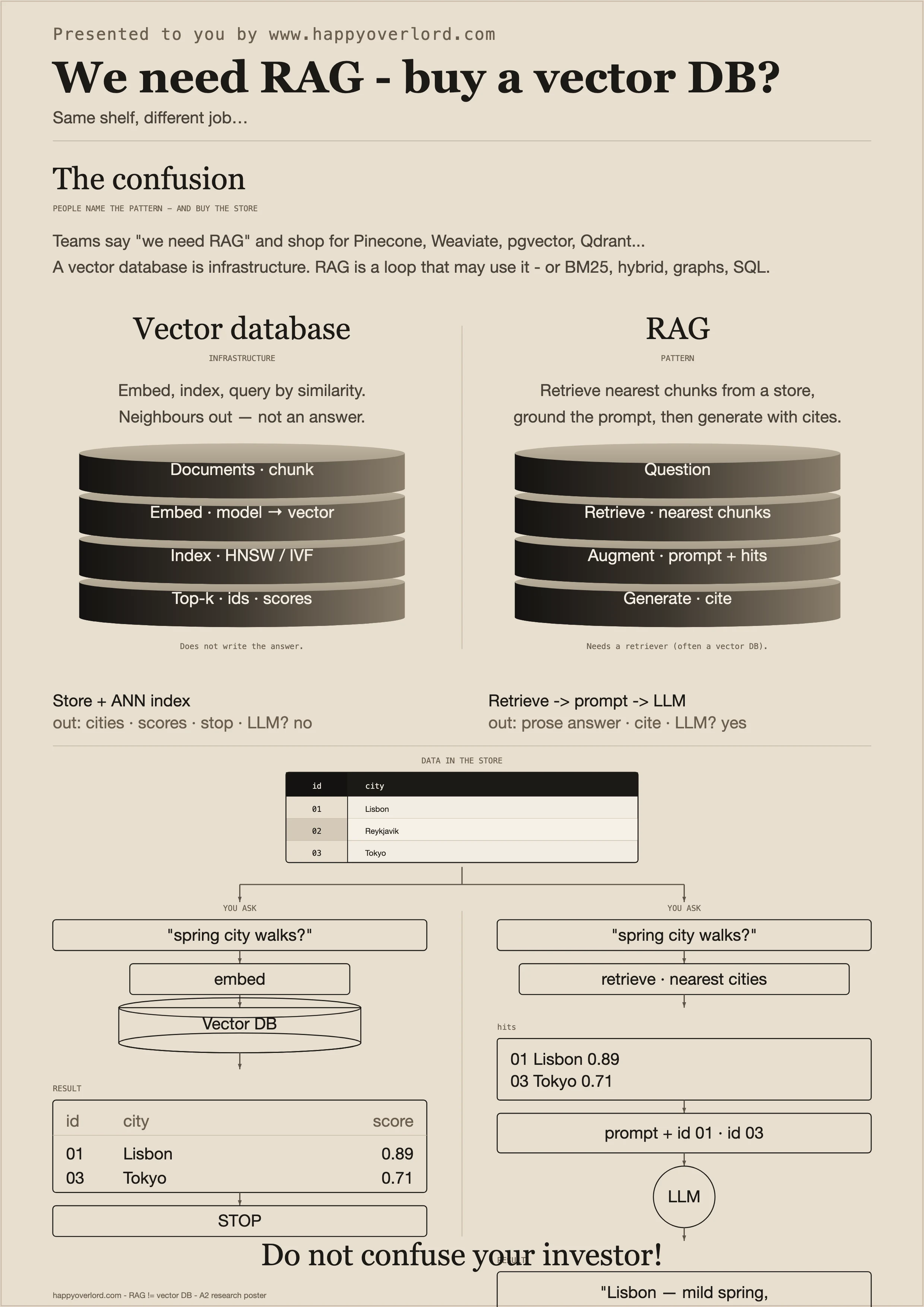
This poster separates two things that get sold as one: a vector database (infrastructure for similarity search) and RAG (a retrieve-then-generate pattern). Buying an index is not the same as grounding an answer.
The headline is the common mistake — “we need RAG, so buy a vector DB.” Sometimes you need the store without the generation loop; sometimes you need RAG with keyword or hybrid retrieval and no dedicated vector product.
The confusion
People name the pattern — and buy the store
Teams say they need RAG and immediately shortlist Pinecone, Weaviate, pgvector, Qdrant, and peers. That shopping list is about storage and approximate nearest-neighbour search.
A vector database is infrastructure. RAG is a loop: retrieve relevant material, put it in the prompt, generate. The loop may use a vector DB — or BM25, hybrid search, graphs, or plain SQL.
- Vector DB = store · index · search
- RAG = retrieve · ground · generate
- They are not the same object
Vector database
Infrastructure — embeddings in, neighbours out
Documents (or rows) are chunked, embedded into vectors, and written into an index (HNSW, IVF, disk-backed variants, and filters). Queries return top-k ids, scores, and payloads.
The database owns storage, ANN search, metadata filters, and scale. It does not write the natural-language answer. An embedding model is required to get into vector space; a generative LLM is not required for search itself.
- Documents → Embed → Vector index → Top-k hits
- Output: ids · scores · payloads — not prose
RAG
Pattern — retrieve → ground the prompt → generate
Retrieval-Augmented Generation fetches relevant passages for a question, augments the prompt with them, then lets the model generate — ideally with citation paths back to the retrieved material.
RAG owns grounding and the “less invented facts” path. It needs a retriever behind it; that retriever is often a vector database, but it does not have to be.
- Question → Retrieve → Augment → Generate → cite
- Retriever may be vector, keyword, hybrid, or mixed
Differences
Store + scores vs retrieve → prompt → prose
Compact lens: vector DB is a store + ANN index (cities · scores · stop; no LLM). RAG is retrieve → prompt → LLM (prose answer · cite; needs LLM).
Worked example under each column — ask “spring city walks?” over Lisbon · Reykjavik · Tokyo. Left stops at ranked cities; right continues through retrieve → prompt → LLM to “Lisbon — mild spring walks” with cite.
Do not confuse your investor!
Same shelf, different job
Closing line only — no separate use-case cards. The travel example above already shows what each side returns: an id table of cities + scores, versus one written answer with cite id 01 Lisbon.
Read black and grey as emphasis on the sheet, not as Claude hooks. The thesis is one line: same shelf in the architecture diagram, different job in the system.
Sources
- Lewis et al., Retrieval-Augmented Generation (RAG)
- ANN indexes: HNSW / IVF family
- happyoverlord.com research posters
Propose a topic
Suggest the next AI infographic. One topic, one glance — what should it make obvious?